 Posted by
 The Story Behind Dutch Brothers Racing
Shereen Shabnam
Success is often measured by promotions, profits and professional milestones. For the founders of Dutch Brothers Racing (DBR), however, true performance is measured in courage and the willingness to step far outside their comfort zone and begin again.
Built alongside demanding executive careers, the Abu Dhabi-based motorsport and leadership platform is not simply about racing; it is about embracing new challenges later in life and proving that resilience, discipline and preparation matter far more than age. Guided by the philosophy Every Lap Has Meaning, DBR documents an authentic journey from complete beginners to competitive endurance racers while translating lessons from the circuit into leadership, teamwork and business performance.
In this interview, the founders discuss how motorsport has reshaped their perspective on leadership, and why their greatest ambition extends far beyond the chequered flag. All About Wheels team explore the DBR journey and uncover the story behind one of the region’s most authentic motorsport ventures.
Dutch Brothers Racing is unlike a traditional motorsport team. What inspired you to create the business, and what problem or opportunity did you see that others perhaps overlooked?
The opportunity wasn’t really a business opportunity at all. It was the chance to go through something hard and unfamiliar like learning to race from scratch, as two executives with no background in it and to share that journey honestly as it happened: the nerves, the mistakes, the progress. If that process ends up testing us in ways that motivate other people to take on their own challenge later in life, that matters as much to us as any single result on track.
The racing is real, and it’s serious that is where the meaning is. The business side of DBR exists mainly to fund the team and keep the enterprise running; it was never the point. What we are testing is whether the discipline we’ve built at work and at home holds up somewhere completely new and whether that’s worth putting in front of an audience.
Both of you left successful corporate careers to pursue a lifelong ambition. What was the defining moment that made you realise it was time to stop saying “one day” and actually make it happen?
One point worth correcting: neither of us has left corporate life, and we don’t plan to. We are both continuing in senior executive roles, and DBR runs deliberately alongside that. This was never a pivot away from our careers it was about setting ourselves a challenge that matched a shared passion and building it in parallel with the work we were already doing.
The defining moment was a conversation between us in Abu Dhabi (our home) on the first day of the regional conflict. We were talking about the projects we’d always intended to start and never had, and there was something about that particular moment that made ‘one day’ feel like a luxury neither of us wanted to keep counting on.
A few months later we were race-licensed and building a programme. There is something genuinely emotional about starting from zero at this stage of life. The nerves before a session are real, and so is the pride afterward, in a way that caught us both off guard. We chose to do it in public not because we had anything to prove, but because if putting it out there keeps us honest and keeps us going, maybe it nudges someone else to stop waiting too. That’s the pattern we’re trying to normalise with personal pursuits alongside the career, not instead of it, not something you quietly save for retirement.
Starting a competitive racing team later in life is a bold decision. What have been the biggest challenges, both professionally and personally in building Dutch Brothers Racing from the ground up?
Professionally, the biggest challenge has been recognising how much of this is media, not motorsport. The racing is the visible part with the car, the track time, the lap chart. Behind it sits everything unglamorous: testing schedules, tyre management, licensing, coaching, safety and logistics. Underestimate that side and you’re done before the season even starts.
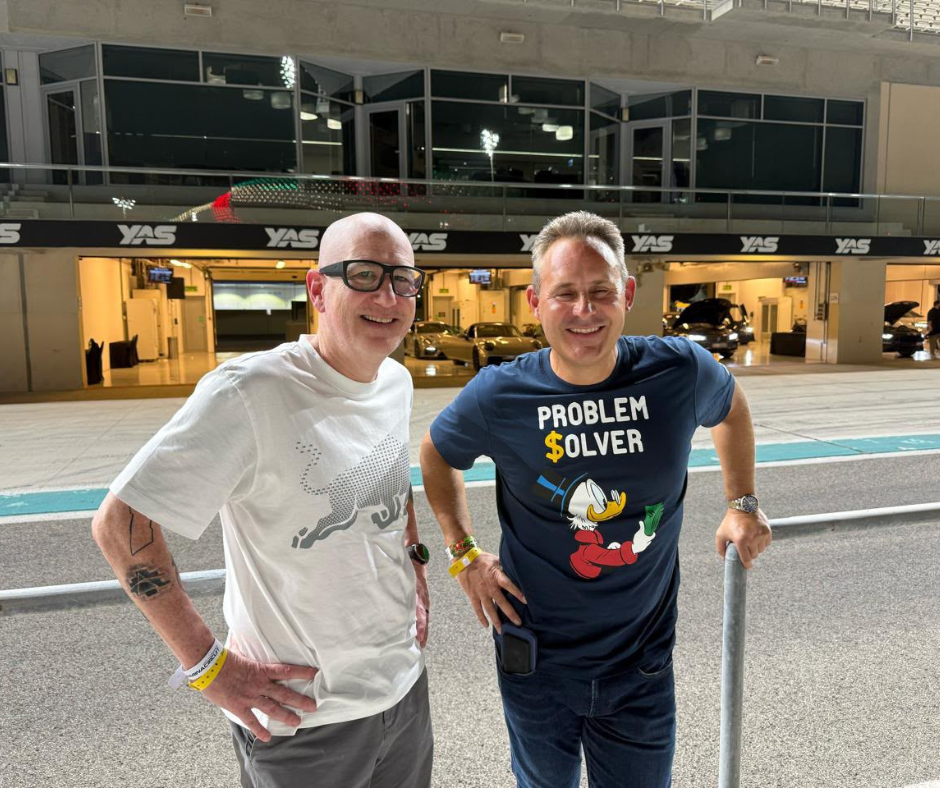
Personally, the deeper challenge has been the discipline of doing this alongside a full executive role and a family. Racing takes time, physical preparation and mental bandwidth, and none of that gets easier just because you’re used to running a business or corporate function instead of a pit wall. There have been early mornings where we’ve genuinely questioned our own sanity but there’s nothing quite like being humbled by a hairpin at an age when you are supposed to have already learned your lessons.
What has helped is running DBR with the same rigour we would bring to any business which is the structure, planning, and a healthy respect for how much we don’t yet know. We had to be deliberate about avoiding the classic executive mistake: throwing process and management structure at something that actually needs humility and a real learning curve.
Your philosophy, “Every Lap Has Meaning,” is central to the brand. What does that phrase mean to you, and how does it apply beyond motorsport?
It captures a specific truth about both endurance racing and life. You don’t win with one heroic lap. You win by making every lap count, consistently, for hours, long after the adrenaline is gone. That’s discipline repeated under pressure and it’s true of anything worth doing: building a business, leading a team, raising a family.
The dramatic moments aren’t where the outcome gets decided. It’s decided in the ordinary work that continues after the excitement fades and usually somewhere around the point your arms are burning and nobody’s watching.
It is also a rejection of the idea that performance belongs to the young. High performance is a product of mindset, preparation and resilience and age is largely irrelevant, whatever our knees and hips have to say about it. If every lap has meaning, then every day of preparation, every honest conversation about a mistake, every deliberate choice to keep going is where results are actually built. That’s true on the track, and off it and there’s real emotion in realising that this later-life chapter might be some of the most meaningful work either of us has done.
Motorsport is often seen as an individual pursuit, yet success depends heavily on teamwork, preparation and trust. What leadership lessons from the racetrack have surprised you the most?
How physical and immediate leadership becomes on a race weekend. In a company you build layers between a decision and its consequence. On the track you feel every choice in your body, in real time no delegation, no filtering, and definitely no forwarding it to someone else to handle. Get a corner wrong and you know within a second. That immediacy has been humbling, and it’s made us better leaders in our day jobs.
The other surprise is how much the outcome depends on the people around you, like the coach, the engineer, the physio, to name a few. In business we know teamwork matters. In racing you feel how much you rely on other people’s judgment when the pressure is highest, and how quickly your ego gets put back in its place when the data simply doesn’t agree with you.
It is a strong reminder that leaders who think they’re the source of performance are usually mistaken. Performance is built collectively, or it isn’t built at all.
You are documenting your journey publicly with the successes, the setbacks and everything in between. Why was authenticity so important to the Dutch Brothers Racing story?
Because the polished version of this story would be worthless. Two executives buying a race car and posting the highlights is bland.
What’s interesting, and what we think is genuinely useful to other people, is the honest version: the things we have gotten wrong, the mechanical failures, the days when the lap times weren’t there, the moments of doubt, and yes, more than a few moments where we have looked fairly ridiculous in the process. All of that is happening anyway. The choice was whether to show it or hide it, so we chose to show it and build the platform around that transparency.
That is really what People. Passion. Performance. means to us in practice. If your brand is authentic and transparent, the audience trusts you, and that trust is what lets us keep competing, keep improving, and keep sharing all of it. Fake it, and it becomes obvious very quickly.
Beyond racing, Dutch Brothers Racing is evolving into a leadership and performance platform. How do you see the lessons learned on the circuit translating into better decision-making, resilience and leadership in the business world?
The disciplines that produce a good lap time are the same ones that produce a good executive decision: preparation before the pressure moment, clarity about what actually matters, composure when things go wrong. Racing magnifies all of that because the feedback is instant and unambiguous you can’t kid yourself about your lap time, no matter how good your excuse is.
What we’re building with the leadership arm is a way to bring that intensity to executives who don’t race. Not necessarily by putting them in a car, but by using the language and structure of high-performance motorsport as a mirror for how they lead their businesses. It maps directly, and honestly there’s something a little funny about how many boardroom problems look exactly like a driver braking too late into a corner.
The vision is a brand that’s as credible in a boardroom as it is in the paddock and using what we have learned in one to sharpen the other.
Looking ahead, what is your long-term vision for Dutch Brothers Racing, and what legacy do you hope to leave for others who may be considering taking a leap into something completely new?
The concrete goal is a competitive finish at the Gulf 12 Hour at Yas Marina in January 2028 as that’s the north star on the racing side. Alongside it: an audience meaningfully bigger than today, partnerships that let us go further and compete at a higher level, and a leadership arm that’s genuinely helping other executives think differently about how they lead.
Beyond that, we would like DBR to be a template for a credible, values-led venture that other people can look at and think, ‘I could do a version of that.’ The legacy matters more to us than any single result. If DBR persuades even a small number of executives that they don’t have to wait for retirement to start something meaningful and that they can pursue it in public, nerves, mistakes and all – that’s the win.
Trophies matter. But so does the message that performance isn’t age-locked, and that a well-lived life includes ambitious late-stage projects. There’s a real emotional undercurrent to that for us, a kind of second wind neither of us expected to find. Every Lap Has Meaning. If we live that, we have done what we set out to do and if we have made a few people laugh along the way, even better.

